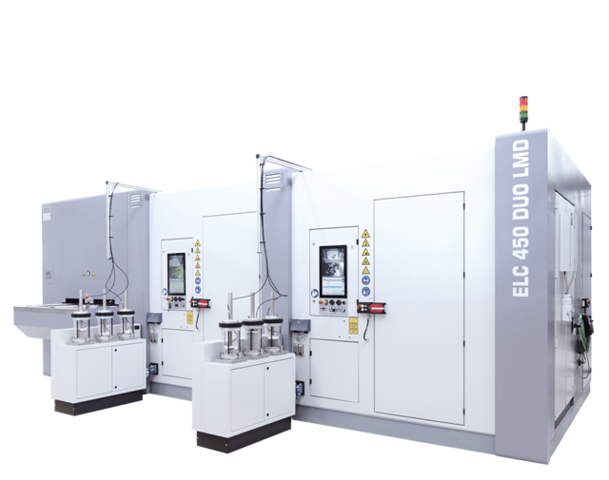
Laser metal deposition of press rolls and printing rolls
Press rollers in the printing and paper industry operate under constant surface pressure, friction, and chemical exposure. Wear on the roller surface leads to loss of print quality, rising maintenance costs, and unplanned production downtime. Laser metal deposition offers a fundamentally new approach to surface protection for these highly stressed components. EMAG LaserTec supplies turnkey production systems for this purpose, enabling industrial series coating of press rollers with maximum process reliability.
What challenges do press rollers face in the printing and paper industry?
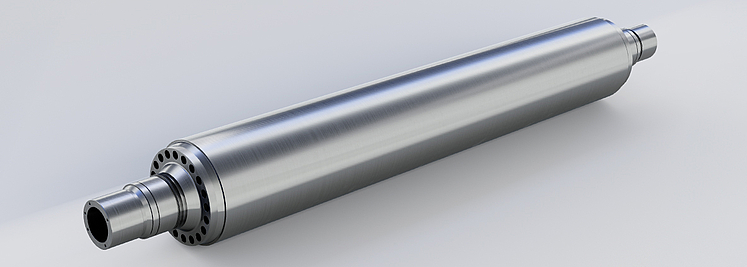
Rollers and cylinders in printing, paper, and packaging machines must exhibit uniform surface quality across their entire length. Even minor deviations in topography or roughness directly affect print density, ink transfer, and the homogeneity of the final product.
At the same time, roller surfaces are subjected to enormous stresses: high line pressures between roller pairs, abrasive wear caused by paper and cardboard webs, contact with printing inks, solvents, alkalis, and wash water, as well as thermal cycling during continuous operation. Conventional coating processes such as hard chrome plating or thermal spraying reach their limits under these conditions—whether due to limited corrosion resistance, micro-fissures caused by stress, or insufficient adhesion to the substrate.
Additionally, regulatory pressure is mounting: The European REACH Regulation is increasingly restricting the use of chromium(VI) compounds in electroplating processes. Operators and manufacturers of printing presses therefore need coating solutions that are more effective, longer-lasting, corrosion-resistant, and future-proof.
How does laser metal deposition of press rolls work?
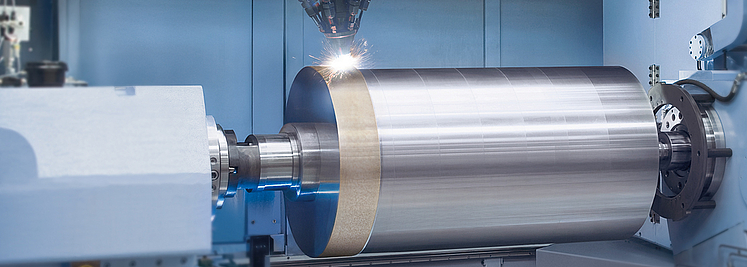
In laser metal deposition, a focused laser beam is directed at the rotating roller surface. A metal powder or wire is precisely introduced into the resulting melt zone, melted, and welded to the base material. The result is a pore- and crack-free functional layer that bonds with the roller body.
The coating process takes place in a single pass along the entire length of the roll. During this process, the process optics move parallel to the roll axis while the workpiece rotates—similar to the principle of a lathe. Through precision control of laser power, feed rate, and powder supply, the coating thickness, hardness, and surface topography can be adapted precisely to the specific application.
A key feature of the process is the extremely limited heat input. The thermal stress is concentrated just a few tenths of a millimeter below the surface. As a result, the microstructure and dimensional accuracy of the roll body remain unchanged—a decisive factor for long, thin-walled rolls that are sensitive to warping.
Why is laser metal deposition superior to thermal spraying for rollers?
Thermal spraying—such as the HVOF process—has been established in the printing and paper industry for years. The coatings produced offer good hardness and abrasion resistance. Nevertheless, the process has inherent weaknesses that are becoming increasingly significant in demanding roller applications.
Coating adhesion and fatigue strength
Thermally sprayed coatings adhere to the substrate through mechanical interlocking. Under cyclic loading—such as that experienced by press rolls in continuous operation—this bond can fatigue. The result is coating detachment, known as spalling. Laser-coated surfaces, by contrast, are metallurgically bonded to the substrate. This welded bond withstands even millions of load cycles without the risk of delamination.
Material utilization and cost-effectiveness
In thermal spraying, up to 40 percent of the coating material used is lost as overspray. In laser metal deposition, material efficiency exceeds 95 percent. For roller manufacturers and operators, this means lower raw material consumption, less waste, and lower coating costs per square meter of surface area.
Porosity and surface density
Due to the nature of the process, thermal spray coatings exhibit a certain degree of residual porosity. Through these micropores, printing inks, solvents, or moisture can penetrate the base material and cause undercorrosion. Laser metal deposition produces completely dense, pore-free coatings that act as a closed barrier against chemical media.
What machine concepts does EMAG offer for the laser metal deposition of rolls?
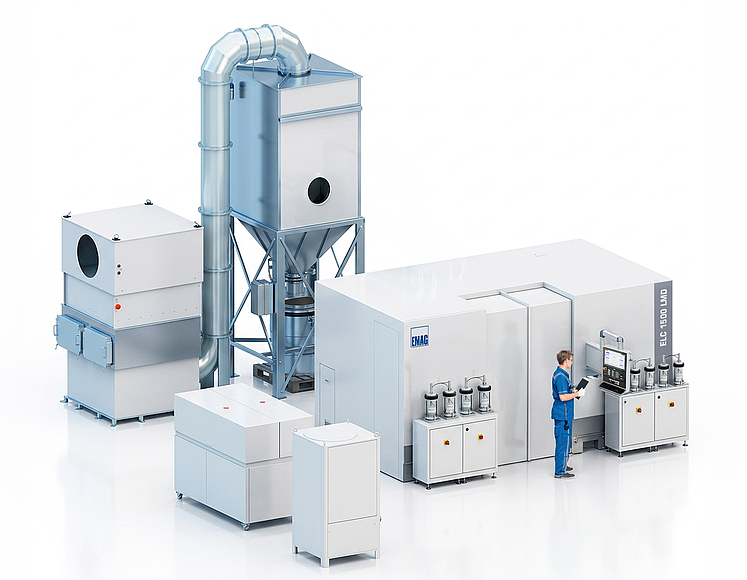
LC 1500 LMD and ELC 2700 LMD – Shaft coating up to 2.7 meters
The EMAG ELC LMD series was specifically developed for coating long, rotationally symmetrical workpieces. The machine design is based on a driven headstock, an electric tailstock, and a high-precision positioning system for the process optics. Powder or wire feed, laser source, cooling unit, and extraction system are fully integrated into the system design.
Technical data for the ELC LMD series:
| Parameter | ELC 1500 LMD | ELC 2700 LMD |
|---|---|---|
| Max. workpiece length | 1,500 mm | 2,700 mm |
| Max. workpiece dia. | 1,000 mm | 1,000 mm |
| Max. workpiece weight | 2,000 kg | 2,000 kg |
| Filler material | Powder or wire | Powder or wire |
This machine platform covers the typical range of dimensions for press rollers in the printing and paper industries. For special dimensions, EMAG develops application-specific solutions upon request.
Integrated sensory equipment and process monitoring
Coating quality is monitored throughout the entire process by integrated sensor systems. This technology originates from high-volume production of brake discs and has been adapted for roller coating. Coating thickness, temperature distribution, and process stability are continuously recorded and automatically adjusted as needed.
For which roller types is laser metal deposition suitable?
The process is suitable for rotationally symmetric components with high requirements for wear protection, corrosion resistance, and surface finish. In the printing and paper industry, this applies to a wide variety of roller types.
01.
Press rolls and calender rolls
In press sections and calenders, rolls with high line pressure are driven against each other. The surface must be hard, smooth, and corrosion-resistant all at once. Laser-coated rolls meet all three requirements in a single functional layer.
02.
Ink transfer rollers and anilox rollers
Rollers that transfer printing ink, varnish, or adhesive require a defined surface topography. Laser metal deposition creates a homogeneous base layer that serves as an ideal foundation for subsequent laser engraving or mechanical texturing.
03.
Drying rollers and heating rollers
Temperatures in drying sections can reach 200 °C and higher. Thermal cycling combined with moisture and chemicals places significant stress on the roller surface. The metallurgically bonded laser coating withstands these conditions without delaminating from the substrate.
04.
Guide rolls and deflection rolls
Even rollers with lower mechanical stresses benefit from laser metal deposition, particularly when used in corrosive environments—such as in the wet sections of paper machines or in facilities within the packaging industry where aggressive cleaning and disinfecting agents are used.
What advantages does laser metal deposition offer specifically for roller applications?
- Consistent coating quality over long lengths
EMAG laser cladding systems process rolls and shafts up to 2,700 mm in length with diameters up to 1,000 mm. Integrated sensor systems monitor the cladding process in real time and ensure consistent coating thickness and quality across the entire roll length—a prerequisite for flawless printing results.
- Wide range of material options
Depending on the roll’s performance requirements, various coating materials are available. Nickel-based alloys offer excellent corrosion protection in chemically aggressive environments. Cobalt-based alloys combine high hardness with temperature resistance. Iron-based alloys with embedded carbides achieve maximum wear resistance. Material selection is tailored to the specific operating conditions in consultation with the customer.
- Minimal post-processing
The surfaces produced by laser metal deposition are already uniform and smooth in their raw state. The subsequent grinding process serves primarily to set the final diameter and the required surface roughness. Time-consuming rework is largely eliminated, significantly shortening the total turnaround time for a roller.
Frequently Asked Questions About Laser Metal Deposition on Press Rolls
- Can existing rolls be re-coated using the laser process?
- What surface roughness values can be achieved?
- How does the coating behave under thermal cycling?
- How does laser metal deposition affect the dimensional accuracy of the roll?
- For what batches is the process cost-effective?
Yes, laser metal deposition is suitable for both new coating applications and the refurbishment of worn rollers. Existing old coatings are removed prior to the laser process, after which the new functional layer is applied directly to the roller body. The metallurgical bond to the base material ensures the same coating quality as with an initial coating.
After laser metal deposition, the rollers are ground achieve the required final diameter and specified surface finish. Roughness values of +/- 15 µm can be achieved. For special applications with different requirements, the parameters are adjusted individually.
Due to the low heat input during laser metal deposition, a coating with minimal internal stresses is formed. The metallurgical bond to the base material ensures that the coating does not detach from the substrate even under repeated temperature cycles. Thermal spraying offers less reliability in this regard, as the mechanical interlocking can fatigue under thermal cycling.
The heat input during laser metal deposition is so low that no measurable distortion occurs in the roll body. This is a critical advantage, particularly for long, thin-walled rolls, compared to processes with higher thermal energy input, such as plasma spraying.
EMAG laser cladding systems are designed for both single-piece and series production. Thanks to the high degree of automation and short cycle times, the system pays for itself even with medium production volumes. For companies that offer roller cladding as a service, the process also opens up new business opportunities.
Machines
(1) machines found