Ammunition for the Defense Industry: Precision Manufacturing for the Highest Demands
From 120-mm mortar ammunition to gun barrels: EMAG delivers complete manufacturing solutions for ammunition production in the defense industry - automated, with reproducible precision, and designed for high-volume production.

Manufacturing systems for ammunition and defense – from individual components to automated lines
Precision and capacity as basic requirements
The requirements for ammunition production in the defense industry are clear: dimensional accuracy with tight tolerances, reproducible quality across hundreds of thousands of components, and manufacturing capacities that can be adapted to changing demands. EMAG offers end-to-end machining solutions for precisely this environment - from single machines to fully automated lines.
Vertical turning machines, USC 850, and TrackMotion for ammunition machining
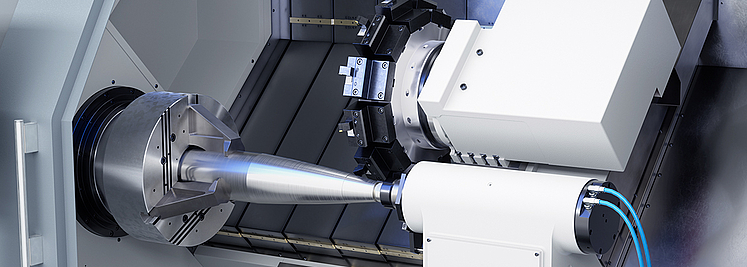
For machining ammunition components such as mortar shells, EMAG relies on vertical pick-up turning machines from the VL and VT series as well as the TrackMotion automation system for link-up of multiple machines. This combination enables short cycle times with minimal personnel requirements. For example, the machining of a 120-mm mortar shell can be completed in just two setups - OP 10 on the VT 4, OP 20 on the VL 8. For large-caliber projectiles such as 155-mm artillery ammunition, the USC 850 is also available; with its robust design and high machining performance, it is specifically designed for machining heavy workpieces.
Electrochemical machining for gun barrels with tension-field profiles
For the production of gun barrels with rifled profiles, the PO 3000 IP is an electrochemical machining machine that operates without mechanical contact between the tool and the workpiece. The ECM process is ideal for I/Ds up to 63 mm and component lengths up to 9,000 mm - and can be scaled up to larger calibers of up to 160 mm.
Advantages
- Reproducible precision in high-volume production: Vertical pick-up turning machines from the VL and VT series ensure consistent dimensions with micrometer precision - even for hundreds of thousands of ammunition components.
- Fully automated production lines: The TrackMotion system seamlessly performs a link-up of multiple machines and handles transport, buffering, and parts flow - with minimal personnel.
- Scalable for any batch size: From a 2-machine cell for flexible small-batch production to a 16-machine line for fully automated high-volume production - EMAG systems grow with your needs.
- Material-saving gun barrel machining via ECM rifling: The electrochemical process alters neither the external geometry nor the material structure of the blank - resulting in a lower scrap rate and lower process costs.
- Comprehensive system expertise from a single source: EMAG supplies machines, automation, and process know-how for the entire spectrum of ammunition production in the defense industry - from mortar ammunition and artillery projectiles to gun barrels.
Questions and Answers
- What manufacturing processes does EMAG use for ammunition production?
- What requirements does ammunition production place on machining accuracy?
- Which EMAG machines are suitable for machining 120-mm ammunition?
- What does a typical process chain for 155-mm artillery shells look like?
- How does ECM rifling for gun barrels work?
- For which calibers and geometries is ECM rifling suitable?
- How can EMAG production lines be adapted to different production volumes?
- What economic advantages does the EMAG process chain offer for ammunition production?
In ammunition production, EMAG primarily relies on turning technology and electrochemical machining (ECM).
Vertical pick-up turning with machines from the VL and VT series is the standard process for machining ammunition casings, projectile bodies, and cover components. The integrated pick-up spindle handles loading and unloading, thereby reducing non-productive time to a minimum. Large-caliber artillery ammunition is machined on horizontal USC 850 machines. For gun barrels with field rifling, ECM Rifling is used: a non-contact, low-wear process for producing precision internal profiles.
Ammunition components demand the highest dimensional accuracy and repeatability, as even minor deviations affect ballistic performance.
For projectile bodies and covers, tight tolerances for roundness, diameter, and surface finish are critical. With ECM Rifling for gun barrels, the non-contact machining ensures that no thermal peripheral zones are created and that the material structure of the barrel remains unchanged - a prerequisite for reproducible ballistic properties.
For 120-mm ammunition - both mortar and tank ammunition - EMAG recommends the link-up of the VT 4 and VL 8, via the TrackMotion automation system.
The VT 4 performs machining of the shell in OP 10 using 4-axis vertical turning, while the VL 8 performs finishing operations in OP 20. For large-scale production, a cell concept with up to 16 VL 8 machines is also available, enabling fully automated production including integrated part cleaning and centralized loading and unloading.
Several USC 850 lathes are used in a link-up system for machining 155-mm artillery shells.
The USC 850 features a maximum turning diameter of 700 mm, a 12-station turret (optionally with driven tools), and a main spindle with a peak power of up to 37 kW. For the artillery shell cover, a process chain consisting of four operations (OP 10 to OP 40) on VL4 machines is standard. These can be fully automated and linked up using the TrackMotion system.
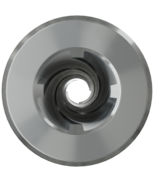
In EMAG’s ECM rifling process, the rifling profile in the gun barrel is created through electrolytic material removal - without mechanical contact between the tool and the workpiece.
A guided cathode is inserted into the deep-drilled barrel. Electrochemical machining removes metal ions from the workpiece. The result is a finished internal profile without thermal effects on the peripheral zones and without any machining allowance. A 3-meter barrel with a 22 mm I/D can be machined in about 35 minutes.
The PO 3000 IP from EMAG ECM is designed for I/Ds up to 63 mm and tube lengths up to 9,000 mm - and is fundamentally scalable to larger calibers.
The process is suitable for small- and medium-caliber barrels, for example for air defense systems, infantry weapons, and applications in helicopters and aircraft. Various internal geometries can be produced: standard rifling, polygonal, and progressive profiles - by changing the cathode modules without time-consuming setup work.
EMAG manufacturing systems for ammunition production are modular in design and can be scaled from a single machine to a fully automated high-volume production line.
For smaller batches, EMAG offers flexible 2-machine cells with optional TrackMotion integration. For high-volume production - such as 120-mm tank ammunition - a 16-machine concept with integrated part cleaning and centralized loading and unloading is available. If demand grows, the system can be expanded to include additional machining steps or calibers without replacing the existing line.
Fully automated production lines from EMAG significantly reduce labor costs and lower unit production costs disproportionately as production volumes increase. Due to the high degree of automation in EMAG manufacturing systems, manual loading and unloading processes are eliminated. This ensures a continuous flow of parts and prevents machine downtime. With ECM rifling, the capital investments are lower compared to hammer solutions, especially when considering OEE including tooling costs.
Workpieces
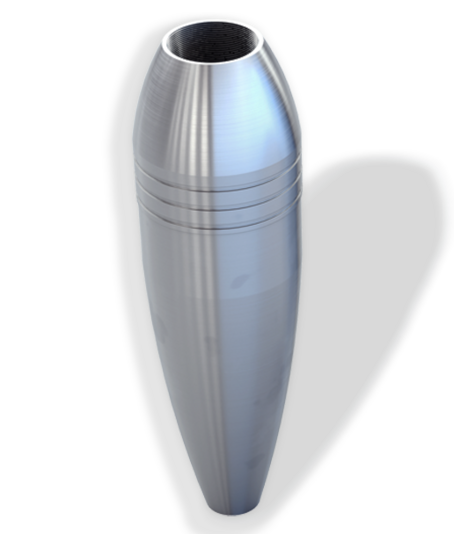
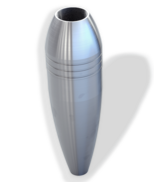
120 mm Mortar Ammunition
Precision is no coincidence – it is the result of a carefully designed manufacturing process. In producing 120 mm mortar ammunition, the machining of the shell is critcal to ensuring the projectile…
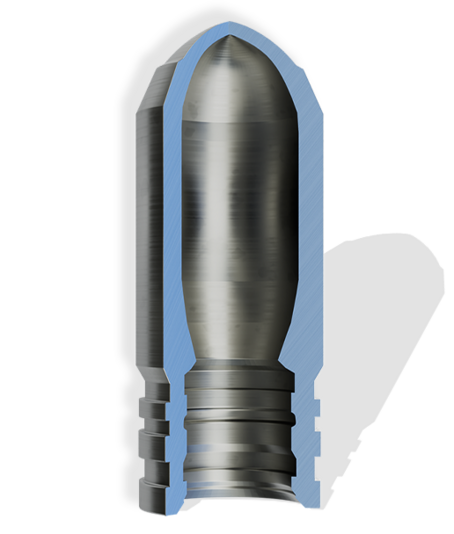
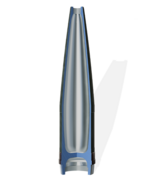
120 mm Tank Ammunition
With its vertical VL 8 pick-up turning machines, EMAG offers customized manufacturing systems for the demanding machining of 120 mm tank ammunition and artillery shells. Our expertise in machining…
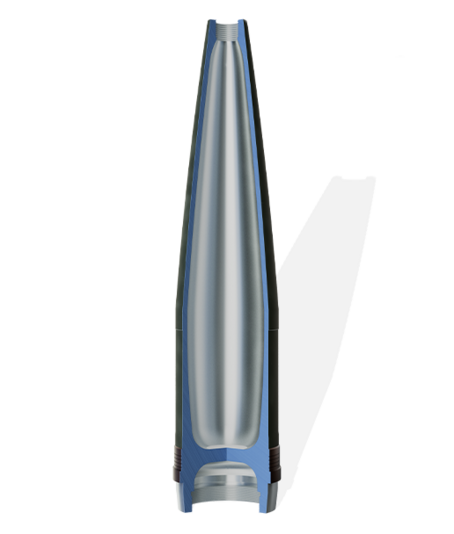
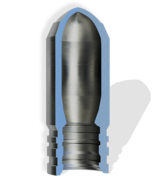
155 mm Artillery Shells
In the defense industry, maximum precision, reliability and efficiency are crucial. The USC 850 from EMAG fulfills these requirements exactly and enables the high-quality turning of 155 mm artillery…
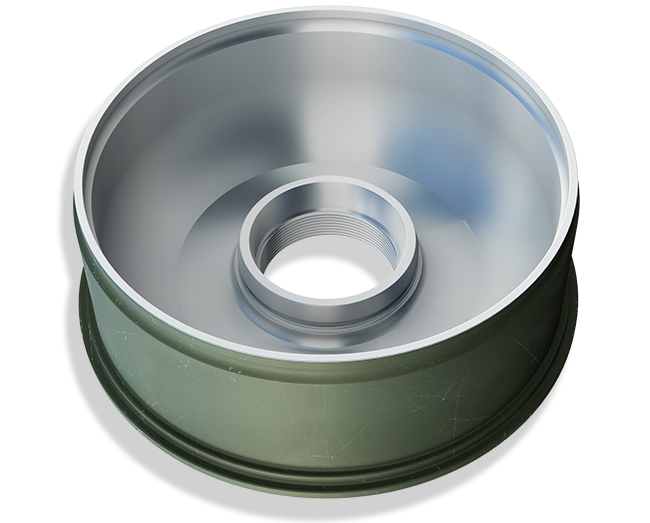
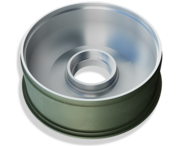
Cover for 155 mm Artillery Shells
As a leading supplier of manufacturing systems for the defense industry, we offer tailor-made solutions for machining covers for 155 mm artillery shells with our high-precision VL 4 machines.
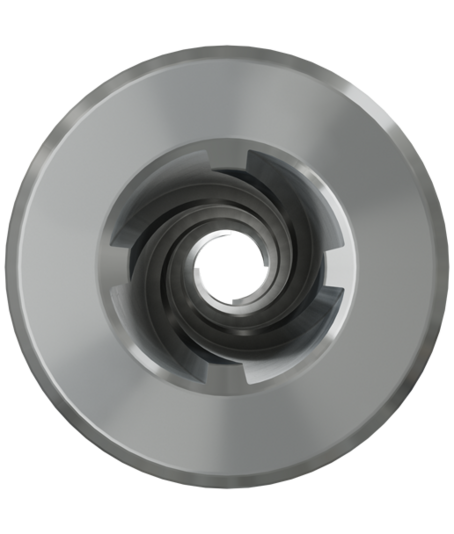
Gun Barrel (ECM Rifling)
The production of gun barrels with tension-field profiles, also known as rifling, demands the highest levels of precision, repeatability and process reliability. The PO 3000 IP from EMAG ECM offers a…