Modern coating technology for plain bearings in wind turbines
Laser cladding is an innovative process for applying wear-resistant layers to metallic surfaces. In wind turbines, for example, plain bearings are increasingly being used instead of rolling bearings, such as on large main shafts (main rotor shafts) and planetary gears in gearboxes. This shift is intended to increase energy efficiency and reduce maintenance costs. Since plain bearings require soft coatings, laser metal deposition is coming into focus: it enables high-quality sliding layers to be applied directly to steel components—a key factor for durable, efficient wind energy components.
But what does laser metal deposition mean? The term refers to the application of a metallic coating using a laser. Technically, it is laser cladding - an established process for producing or repairing very high-quality coatings.

Typical applications: Main shafts and planetary pins in wind turbines
Wind turbines are subjected to extreme loads and continuous stress. In particular, main shafts, which transmit the force of the rotor blades to the gearbox, and planetary pins - the journals on which the planetary gears in the gearbox run - must withstand high forces. Until now, these components have often been equipped with rolling bearings (e.g., roller or ball bearings). However, modern wind turbines are increasingly relying on plain bearing solutions to reduce friction losses and thus increase service life.
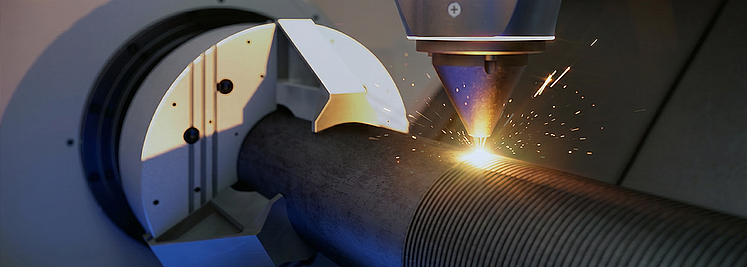
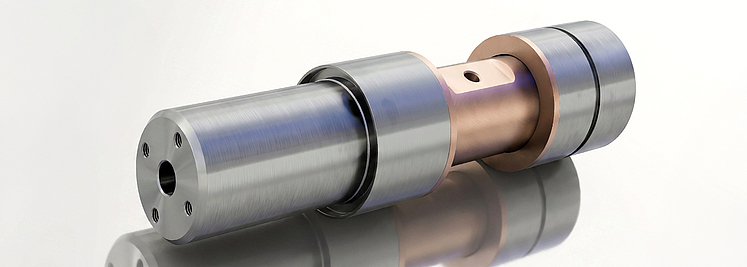
To retool for plain bearings, the surfaces of these components must be coated with a suitable soft metal. This is exactly where laser metal deposition comes into play. A typical example is laser-clad planetary pins in the latest wind turbines. Laser metal deposition allows a thin layer of plain bearing material (such as copper-tin bronze or white metal) to be applied to the steel surface of the pins or shaft journals. This layer acts as a sliding bearing surface, which, in combination with a suitable mating bearing (e.g., a bearing shell segment), forms a low-friction plain bearing.
The coating ensures important tribological properties: on the one hand, it protects the steel from wear. On the other hand, it enables so-called emergency running properties - that is, the bearing’s ability to continue functioning without immediate failure in the event of a short-term loss of lubricating oil. Without such a soft sliding layer, steel-on-steel pairings would quickly suffer seizure damage if the lubricating film breaks down. Copper-tin alloys (bronzes) or white metals offer excellent sliding properties and, thanks to their soft surface, prevent seizing during emergency operation. Laser metal deposition of these materials on large shafts and bolts is therefore the key to reliably using plain bearings in wind turbines.
Advantages of laser cladding over casting and thermal spraying
Laser cladding offers numerous technical and economic advantages over traditional coating methods such as casting bearing shells or thermal spraying.
- Higher bond strength: layers applied by laser are welded to the base material with a material bond and achieve significantly higher adhesion strength than coatings produced by casting or thermal spraying. Especially when compared to thermal spraying—which only creates a mechanical bond between the particles and the surface—the metallurgical bond achieved in laser cladding ensures significantly more durable and resilient coatings.
- Reduced material and energy consumption: Laser cladding is extremely resource-efficient. Compared to traditional centrifugal or furnace casting of bearings, over 70% of non-ferrous metals can be saved, as only the exact required layer thickness is applied instead of casting a thick bronze liner. At the same time, energy consumption is reduced by around 90% compared to the casting process, because the laser process melts material only locally and large quantities of molten material do not need to be kept at temperature for extended periods. Overall, laser cladding is thus significantly more environmentally friendly and cost-effective in operation.
- Improved emergency running properties through tin- and copper-containing materials: Since virtually any alloy can be applied during laser metal deposition, specially developed bearing bronzes or white metals can be used. These soft copper- and tin-containing coatings give the bearing excellent emergency running properties—meaning the bearing can continue to run for a while without serious damage even in the event of insufficient lubrication or a brief oil failure.
- Process integration and high precision: Laser cladding systems can be integrated into a production line because they are relatively compact and do not require a separate foundry area. Components can be further processed on the same system immediately before or after cladding, which minimizes logistical effort. The laser applies energy to the workpiece with high precision and in a localized manner. As a result, surrounding areas are barely affected. This minimizes warping and enables the best possible dimensional accuracy of the component. Laser parameters can also be precisely controlled, ensuring uniform layer thicknesses and reproducible results. Even complex geometries or hard-to-reach areas can be uniformly coated using multi-axis optical guidance—far better than would be possible with conventional methods.
Laser Cladding in Use
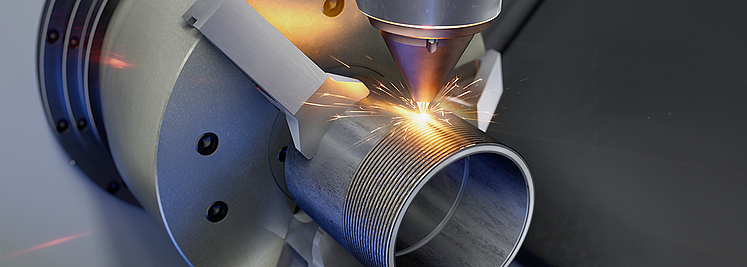
In laser cladding, a powdered metal material or a wire is applied as a solid layer to a component using a high-intensity laser beam. A focused laser beam creates a localized molten pool on the workpiece surface. In this molten pool, the deposited filler material bonds with the base material. The liquid metal solidifies within milliseconds, forming a dense weld bead that is firmly fused to the substrate. By placing such weld beads (tracks) slightly offset next to one another and, if necessary, applying multiple layers, a homogeneous layer with the desired diameter is created.
High-power diode lasers are typically used as the energy source.
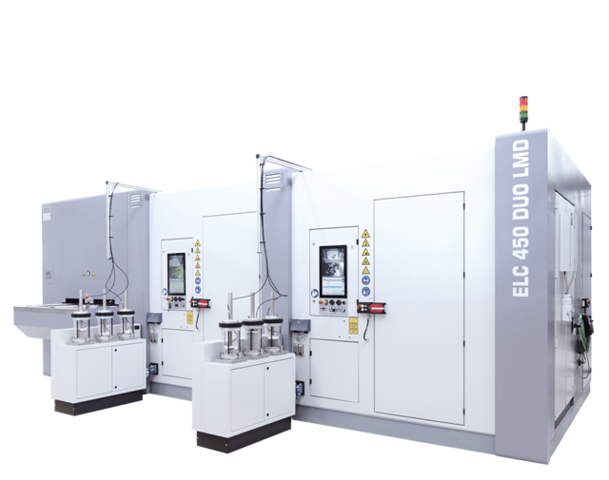
EMAG ELC 1500 LMD – High-performance system for laser cladding
The ELC 1500 LMD was specifically designed to efficiently laser-clad workpieces weighing up to 2 tons and measuring up to 1.5 meters in length. This makes the ELC 1500 LMD ideal for components such as wind turbine main shafts or axles, which are very large and massive. Thanks to a reinforced machine base and a stable tailstock, even such heavy components can be clamped with precision and moved safely during coating.
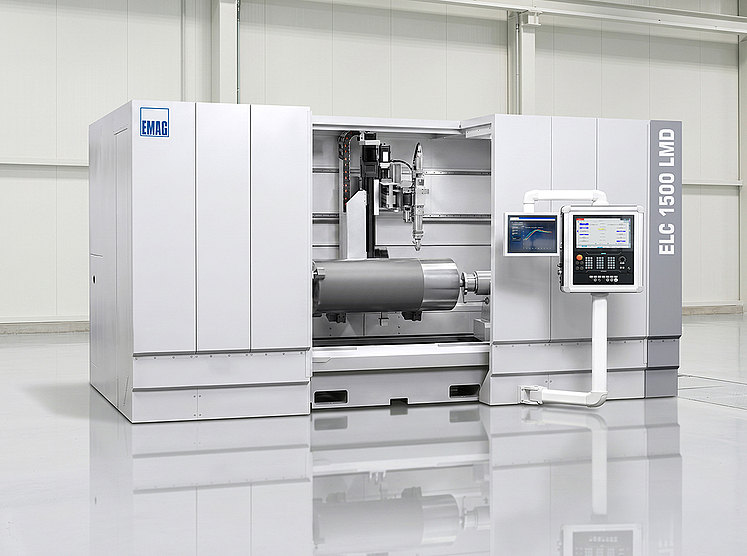
The ELC 1500 LMD utilizes state-of-the-art laser and drive technology. At its core is a process optics system that—driven by up to four NC axes—positions the laser beam with high precision. Specifically, this means the optics can be moved in the X, Y, and Z directions and additionally angled to optimally follow every point on the component. This multi-axis movement greatly increases flexibility: even complex contours or hard-to-reach areas (e.g., the inner surfaces of large bearing shells) can be reliably coated, as the beam can always strike at the correct angle. The repeatability of the positioning is extremely high—deviations from layer to layer are minimal, ensuring consistent results.
Ergonomics and integration were also taken into account in the ELC 1500 LMD. The machine features a spacious work area that is accessible from the front. Large components can be easily loaded and unloaded using a crane or lifting aids (manipulator). Maintenance work on the laser or optics is facilitated by the open design . All necessary components—from the beam source to the extraction system for smoke and particles—are integrated into the system design and can be flexibly arranged. This means the complete laser cladding solution comes from a single source and requires only a suitable location in the production facility. Cooling systems for the laser as well as protective enclosures are part of the system, ensuring safety and reliability.
In summary, laser cladding achieves higher joint quality, enables the use of high-performance bearing materials, saves material and energy, offers processes with precise control over temperature conditions without significant thermal side effects, and requires no additional cooling media. These advantages make it an extremely attractive technology for coating plain bearings in wind energy applications.
Machines
(1) machines found